
Industry professionals know: cores won't bond, amorphous strips delaminate, VOCs exceed limits during impregnation, potting cures too slowly. Often, the issue isn't poor process—it's a lack of a cohesive material system.
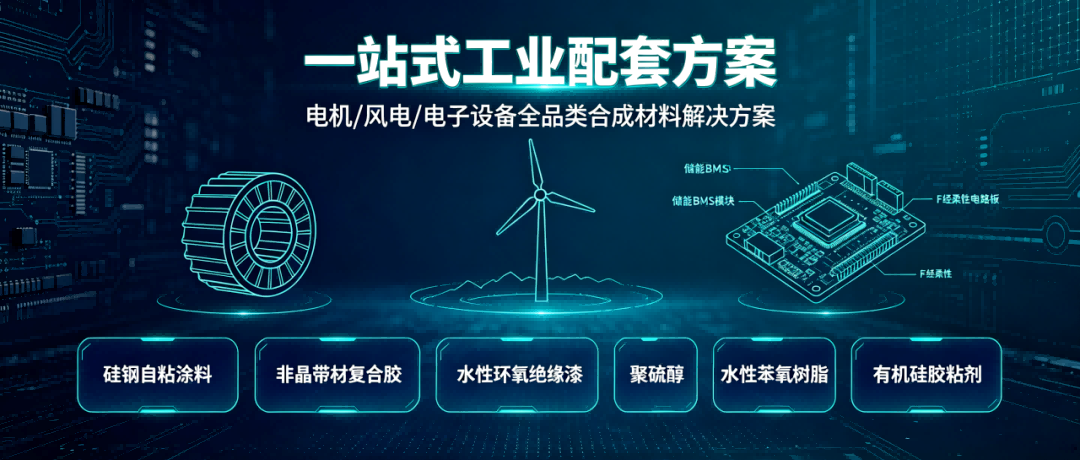
Guangzhou Feisi Synthetic Materials Co., Ltd. leverages its six core product lines—silicon steel self-adhesive coatings, amorphous tape composite adhesives, water-based epoxy insulating varnishes, polysulfides, water-based phenoxy resins, and silicones—to upgrade from single-product sales to "process-grade bundled solutions" covering the motor, wind energy & storage, and electronics & electrical sectors.
I. Four Core Product Solution Suites
Option 1: Composite package of amorphous/nanocrystalline ribbons
Core Products: Amorphous Strip Composite Adhesive + Silicon Steel Self-Adhesive Coating
Key Parameters:
Bond strength: 20-30 μm; Interlayer peel strength of amorphous ribbon: 1.8 N/mm (after hot pressing at 180°C)
Curing condition: Single-component water-based epoxy composite adhesive 160-180°C × 10-20 min hot press curing
Shelf life: Single-component; apply within 8 h after opening at 25°C (no skin formation during storage).
Application scenarios: amorphous transformer cores, magnetic amplifiers, high-frequency inductors, and reactors.
Solution Logic:
Amorphous Strip Composite Adhesive – Controls Wetting and Initial Tack to Prevent Brittle Fracture and Interlayer Slippage
Silicon Steel Self-Adhesive Coating — Provides a coupling layer as the top adhesive.
Solve pain points:
Springback after winding amorphous strip
Long-term interlayer delamination noise
Insulation decreases after the adhesive layer absorbs moisture.
Customer Value: Improved amorphous core yield, optimized for 10kHz+ high-frequency conditions
Solution 2: Self-adhesive Insulation Wrap for High-Efficiency Motor Cores
Core Products: Self-adhesive Silicon Steel Coating + Water-based Epoxy Insulating Paint
Key Parameters:
Bond Strength: Interlayer T-peel strength 2.5-4.2 N/mm (dry film thickness 14 μm, hot-pressed at 160-180℃); Normal-state shear bond strength of silicon steel self-adhesive coating reaches up to 26 MPa class (based on actual tests of waterborne epoxy self-adhesive paint in the same system).
Curing conditions: 150-220°C × 5-30 min (hot-press pressure 1-3 MPa) with B-stage active film lamination; complementary waterborne epoxy insulating varnish reinforcement: 120-130°C × 2-3 h.
Shelf life / Storage: For single-component waterborne systems, the original sealed container maintains activity for 6 months at 25°C. After coating, the B-stage film can be stored at room temperature in the workshop (30°C) for up to 72 hours before hot pressing.
Application scenarios: New energy vehicle motors, servo motors, and compressor stator/rotor cores
Solution Logic:
Silicon Steel Self-Adhesive Coating — Enables self-bonding of silicon steel laminations to enhance core integrity and rigidity
Water-based Epoxy Insulating Varnish — Surface Sealing + Interlayer Reinforcement; Resists Humid Heat and Freezing Oil
Solve pain points:
High eddy current losses in riveted/welded cores
High-speed motor core squeal and loosening
Oil-based paint VOC emissions are difficult to meet standards.
Customer Value: Core loss reduced by 5%-10%, improved NVH performance, and compliance with green factory environmental audits.
Solution 3: Heavy-duty potting enclosure for wind power energy storage
Core Products: Mercaptan-Based (Fast-Cure) + Silicone Sealants & Coatings
Key Parameters:
Bond strength: thiol/EP (E51, 1:1) cured at 25°C for 4 h; shear strength 22 MPa. After full cure in a 0°C environment for 4 h, shear strength is 20 MPa. Peel strength of the silicone coating on AL/PCB: 1.2 N/mm.
Curing conditions: 25°C × 1-3 h demold, 0-5°C × 4-6 h full cure (traditional amine systems remain uncured at this stage); silicone outer layer skin-dries at room temperature in 10-30 min and fully cures in 24 h.
Curing time: 25 min after mixing at 30–40 °C (gel time approx. 25–30 min); extends to 60–90 min at 0 °C, ideal for on-site adhesive mixing and emergency repairs
Application scenarios: wind turbine pitch controllers, energy storage BMS modules, combiner boxes, and outdoor power stations.
Solution Logic:
Thiol-Modified Epoxy: Low-Temperature Rapid Curing Potting Compound — Solves the Critical Issue of Non-Curing in Outdoor Winter Conditions
Silicone Coating — Enclosure Sealing, Junction Box Potting; UV Resistant, Salt Spray Resistant, Flame Retardant V-0
Solve pain points:
Slow curing during on-site construction in northern winter
Sealant cracking due to large day-night temperature fluctuations
Flame Retardant + Thermally Conductive + Narrow Process Window
Customer Value: Operable down to -5°C, repair timeline reduced by 50%, outdoor lifespan doubled.
Option 4: Precision Electronic FPC Specialized Adhesive Kit
Core Products: Waterborne Phenoxy Resin + Silicone Adhesive/Thermal Conductivity Systems
Key Parameters:
Bond Strength: Waterborne phenoxy resin-modified FPC reinforcement adhesive; PI-PI peel strength 0.8 N/mm, no delamination after reflow soldering at 260°C for 3 cycles. Silicone thermal conductive bonding pad: compressive stress 0.5 MPa @ 25% strain, shear strength 1.5 MPa.
Curing conditions: Waterborne phenoxy resin system at 120-150°C for 15-30 min (or air-dry with waterborne isocyanate curing agent at room temperature for 24 h); Organic silicon thermoset type at 120-150°C for 10-20 min; Room-temperature addition-cure type at 25°C for 24 h.
Pot life: 25 hours for two-component organic silicon after mixing A and B at 24°C; waterborne phenoxy resin single-component remains usable for 6 months in the original container, and must be used within 4 hours after adding the curing agent.
Application scenarios: FPC reinforcement, sensor encapsulation, thin-film circuit lamination, and high-temperature labels
Solution Logic:
Water-based phenoxy resin — High toughness, low-stress bonding for flexible substrates
Silicone Pressure-Sensitive/Thermoset Adhesive — Withstands 200°C+ Reflow Soldering, No Yellowing
Solve pain points:
PI film curling after high-temperature exposure
Brittle adhesive layer causing micro-cracks in traces
Solvent-based adhesive residue odor/toxicological risk
Customer Value: Halogen-free and phenol-volatile-free; suitable for export-grade electronic components (RoHS/REACH compliant).
II. Industry Bundle Adaptation = Technical Safety Net
Guangzhou Feisi's "Packaging Solution" is not a simple order consolidation, but BOM-level material combination recommendations.
Customers just need to say | Feishu output |
|---|---|
Motor Power / Speed | Silicon Steel Self-Adhesive + Insulating Varnish Process Card |
Amorphous Strip Thickness & Frequency | Composite Adhesive Solid Content + Coating Method |
Minimum outdoor construction temperature | Thiol Ratio + Pot Life |
Export Certification Requirements | Water-based System Compliance Package |
Compared to traditional models:
Traditional: Source resin from Factory A, additives from Factory B, and insulation varnish from Factory C.
Feisi: 1 contracts, 1 sets of MSDS/TDS, 1 process validations
3. Where does the cost reduction come from?
No wasted performance: Precision grading of waterborne epoxy and waterborne phenoxy systems avoids forcing higher temperature ratings.
Automates manual processes: Replaces riveting with self-adhesive silicon steel, eliminating the core shaping step.
Boost production capacity: Thiol-ene systems demold at room temperature in 1–2 hours, doubling mold turnover rate.
Eco-Friendly, Zero Risk: Water-Based Solution Delivers Complete Compliance—No Post-Installation VOC Remediation Costs
IV. Guangzhou Feisi's Technical Foundation
Proprietary Product Line: Silicon Steel Self-Adhesive Coating / Amorphous Composite Adhesive / Waterborne Epoxy / Waterborne Phenoxy Resin / Polysulfide / Silicone
Available: TDS + MSDS + Third-party insulation/flame-retardant/environmental compliance test reports
Supported: Lab-scale testing → Production line support → Bulk supply assurance
Location: Guangzhou Base, Pearl River Delta. 4 8-hour commute to facility; dedicated transport/logistics direct dispatch from other regions.
V. Frequently Asked Questions
Q1: What are the key advantages of self-adhesive silicon steel coatings compared to traditional riveted or welded cores?
Feis Silicon Steel Self-Adhesive Coating bonds laminations into a single unit, reducing iron losses by 5%-10% compared to riveting or welding. It eliminates core loosening and squeal (improving NVH) while removing the need for trimming and deburring steps. Ideal for new energy and servo motors requiring high efficiency and low noise.
Q2: Amorphous ribbons are brittle. How does your composite adhesive address cracking and springback?
Fei Si Amorphous Composite Tape Adhesive is engineered for 20-30μm thin strips. It offers controllable initial tack and excellent wetting. When used with a water-based phenoxy resin primer at the interface, it effectively cushions winding stress, suppresses recoil and interlayer slippage, and reduces edge brittleness risks during annealing or operation. Ideal for amorphous transformers and high-frequency inductors.
Q3: Epoxy potting compound cures slowly or not at all during outdoor winter construction. Do you have a solution?
Our flagship product is a thiol-modified rapid-cure system that cures normally at temperatures as low as -5~5°C. It reduces surface drying and demolding times by over 60% compared to conventional amine-cured epoxies, making it ideal for winter outdoor emergency repairs or northern projects involving wind turbine pitch control cabinets, energy storage BMS units, and combiner boxes.
Q4: With stricter environmental regulations on oil-based insulating varnishes, will waterborne epoxy insulating varnish compromise performance?
Frees Water-Based Epoxy Insulating Varnish offers thermal ratings from 130 to 155°C (Class B/F). Its dielectric strength and coating weight are third-party verified, meeting the needs of small-to-medium motors, stator impregnation, and core sealing. With significantly reduced VOC emissions, it is ideal for export orders and factories requiring environmental compliance audits.
Q5: Where are water-based phenoxy resins primarily used, and how do they differ from PU or standard epoxy?
A: Waterborne phenoxy resin's core advantages are high toughness, low stress, and hydrolysis resistance. It is ideal for electronics applications requiring "rigid yet non-brittle" performance, such as FPC reinforcement, flexible circuit lamination, and sensor encapsulation. Compared to standard epoxy, it reduces PI film warping; compared to PU, it offers superior thermal and chemical resistance.
Q6: Do your silicone products focus on sealing or thermal conductivity?
A: The fensil silicone system spans two ends: one is electronic-grade thermal/conformal/encapsulating adhesive (1.0-3.0W, general purpose), and the other is structural sealant/weather-resistant adhesive (UV resistant, salt spray resistant). Often paired with polysulfide encapsulation, it forms an "hard inside, soft outside" outdoor equipment protection package.
Q7: Do you support small-batch sampling, or do you only handle ton-scale bulk orders?
A: Supports the full chain from R&D prototyping to small-batch validation and mass production supply. All four packaging solutions offer 5-15kg sample kits, accompanied by process parameter cards to reduce customer trial-and-error costs.
Q8: Will bundled purchases or individual items cost more?
Actually, it's more controllable. The packaging solution automatically eliminates over-specification based on operating conditions (e.g., won't push H-grade if 180℃ isn't required) while achieving dual cost savings in materials and management through consolidated MOQs, unified logistics, and reduced defect rates.
Q9: Is the documentation compliant? Can it be used for export projects?
Fotric provides comprehensive TDS, MSDS, RoHS, and REACH reports. For water-based systems, we can also supply VOC test data to help customers meet export certification requirements and pass downstream facility audits.
Q10: How to quickly get the adaptation solution?
Just provide 3 details: industry/device (e.g., amorphous transformer), key operating conditions (e.g., 120°C/humid environment), and certification status (UL/ROHS/not required). We'll deliver a tailored solution.
6. Contact Information
Guangzhou Faith Synthetic Materials Co., Ltd.
Phone: 020-XXXXXXXX
Website:www.gzfaith.com
Address: XXXXXX, Huangpu District, Guangzhou
To obtain a customized solution or samples, please contact the Guangzhou Feisi operations team using the methods above. Provide your industry, equipment type, and key operating parameters, and we will quickly deliver a tailored material combination plan.