
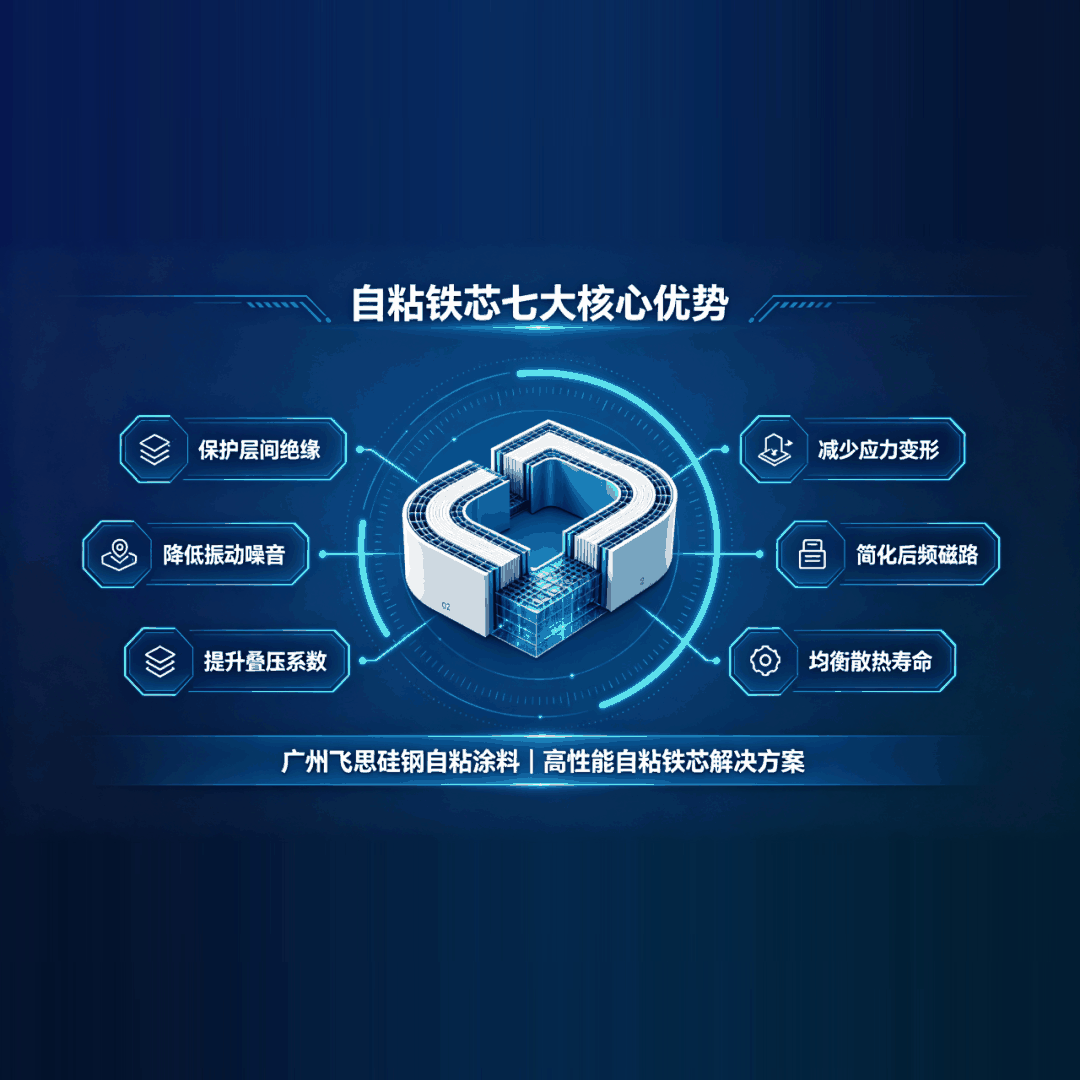
The motor core is the magnetic heart of the motor. Traditional core formation relies on riveting or welding. As demand for energy efficiency, NVH performance, and power density grows in new energy motors, high-speed servos, and industrial robots, self-bonded cores made with Guangzhou Feisi's self-adhesive silicon steel coating are becoming the preferred solution for premium applications.
What advantages do self-adhesive cores offer over riveted or welded assemblies? This article explains them step by step, starting with the underlying process principles.
1. What is a self-adhesive core?
Self-adhesive iron cores represent a next-generation lamination process, relying on silicon steel self-adhesive coatings for成型. A specialized adhesive coating is pre-applied to the surface of silicon steel sheets. After stacking, low-temperature heating and pressure trigger cross-linking and curing of the coating, uniformly bonding all stamped laminates into a single unit across their entire surfaces—eliminating the need for rivet piercing or spot welding, thereby addressing structural defects inherent in traditional manufacturing methods at the source.
In comparison:
Riveting Process: Mechanical compression and locking of stacked laminations using rivets.
Welding Process: Bonds laminates locally via high-temperature fusion
Adhesive Process: Uniform full-surface bonding for seamless, integrated formation
Both riveting and welding directly damage the original insulation coating on silicon steel sheets, generating mechanical or thermal stress—the primary cause of core performance loss.
II. Seven Core Advantages of Self-Adhesive Cores
Advantage 1: Fully preserves interlayer insulation to reduce eddy current losses and strictly control core temperature rise.
The high heat of welding and the mechanical compression/piercing from riveting locally damage the insulation coating on silicon steel sheets, creating numerous interlayer short circuits. The more short-circuit points exist, the higher the eddy current losses, directly causing increased core temperature rise and reduced motor operating efficiency.
The lamination temperature in the self-adhesive process remains below the damage threshold of the silicon steel insulation coating, ensuring no mechanical puncture or structural compromise. This preserves the native insulation integrity of the silicon steel sheets, verified by interlayer insulation resistance testing per GB/T 2522.
Measured data: Under identical conditions, the 0.35mm non-oriented silicon steel core of the same specification shows approximately 12% lower core loss and a temperature rise reduction of 8 K with the self-adhesive process compared to the spot-welding process.
The cured self-adhesive coating forms a continuous, dense insulating protective layer with excellent interlayer insulation stability. It effectively reduces eddy current and hysteresis losses, meeting the long-term reliability requirements of high-efficiency energy-saving motors and new energy drive motors.
Advantage 2: Fully integrated molding reduces inter-layer vibration and optimizes motor NVH performance.
Traditional riveting relies solely on discrete rivet points, while welding depends on localized weld seams, leaving micro-gaps between laminations. During high-speed motor operation, these gaps cause high-frequency micro-vibrations that trigger electromagnetic resonance and amplify operational noise—a primary reason for failing NVH compliance.
The self-adhesive process uses full-surface bonding to form a monolithic structure. This ensures uniform rigidity across the entire core, eliminates gaps and loosening between laminations, and prevents uneven local stress, effectively suppressing high-frequency vibration of the laminations.
Actual Test Data: Compared to riveted and welded cores, self-bonded cores can reduce operating noise by 3-8 dB. They are particularly suitable for high-noise and vibration-sensitive applications such as high-speed servo motors, automotive drive motors, and precision spindle motors.
Advantage 3: No structural loss, higher stacking factor, and improved motor power density.
Riveting requires pre-drilled holes, consuming effective lamination space; welding's high heat causes local warping and deformation. Both processes reduce the stacking factor, limiting motor power density improvements.
Rivet-free, weld-free self-adhesive cores maintain structural integrity without deformation. Laminations bond tightly and uniformly; under testing conditions excluding adhesive layers, the stacking factor reaches 98%–99%, significantly outperforming traditional methods. For equivalent core volume, the self-adhesive structure delivers higher magnetic flux, enabling compact, lightweight motor designs.
Advantage 4: Uniform stress release, high forming precision, and compatibility with complex irregular structures.
Mechanical compressive stresses from riveting and localized thermal stresses from welding cause core warping and deformation, compromising stator-rotor coaxiality. This significantly increases rework costs for subsequent shaping and results in poor forming consistency.
The self-adhesive coating cures with a mild reaction, enabling uniform stress release across the entire area and eliminating local stress concentrations. This results in minimal core deformation and significantly improved dimensional consistency and coaxiality precision. Additionally, it supports complex core structures—including ultra-thin, narrow-slot, irregular, and micro designs—addressing the industry pain point of being unable to machine precise irregular cores with traditional riveting and welding processes.
Advantage 5: Extremely simple process, no secondary contamination, compatible with automated mass production lines.
Welding generates slag, oxide scale, and burrs, requiring additional post-processing steps such as grinding, descaling, and cleaning. Riveting involves multiple stages—including punching, rivet fitting, pressing, and verification—resulting in high material consumption, labor costs, and low mass production efficiency.
The self-adhesive iron core is molded in a single hot-press curing step, eliminating the need for grinding or secondary cleaning. The surface remains clean and free of impurities, significantly streamlining production processes while reducing labor costs and scrap rates. Fully compatible with automated stacking and curing lines.
Advantage 6: Continuous, undistorted magnetic circuit ensures stable electromagnetic performance under high-frequency conditions.
Rivet holes and discontinuities in weld seams break the continuity of the core magnetic path, causing local abnormal magnetic resistance and uneven magnetic saturation. Under high-frequency variable-speed conditions, additional losses surge sharply, leading to motor performance degradation.
The self-adhesive iron core ensures a continuous, uninterrupted magnetic circuit with no structural breaks. This eliminates local flux distortion and saturation caused by rivet holes or weld points, delivering superior electromagnetic output stability under high-speed variable frequency, high-frequency servo, and dynamic vehicle operating conditions.
Advantage 7: Uniform cooling across the entire area eliminates hot spots and extends motor service life.
Welded heat-affected zones and rivet fastening points can create structural dead zones and stress concentrations. Uneven interlaminar gaps lead to significant variations in thermal resistance, causing localized hotspots during operation that accelerate thermal aging of insulation materials.
Self-adhesive core laminations bond tightly with uniform, low interlayer thermal resistance for rapid heat dissipation across the entire area. This effectively minimizes local hot spots, slows insulation aging, and extends the overall service life of the unit.
III. Comparison Table of Eight-Dimensional Parameters for Three Core Manufacturing Processes
Comparison Criteria | Self-adhesive Core | riveted core | Welding the core |
|---|---|---|---|
Iron loss performance | Reduced core loss by 12%, temperature rise reduced by 8K, and extremely low losses. | Moderate: Point insulation damage, elevated eddy current loss | High, large thermal damage area, significant increase in iron loss. |
NVH Performance | Seamless full-surface fit with vibration damping and noise reduction, delivering superior high-frequency noise performance. | Fixed mounting points have gaps, prone to vibration, and exhibit average noise performance. | Welds are prone to deformation, exhibit noticeable resonance, and have poor high-frequency noise performance. |
compression ratio | 98%~99% (calculated without adhesive layer) | 94%~96% (rivet hole space occupied) | 95%~97% (weld prone to warping) |
Dimensional Accuracy | Stress-free deformation with exceptional coaxiality and consistency. | Mechanical extrusion is prone to deformation; molding precision is moderate. | Thermal stress warping with significant dimensional deviation |
Post-processing | No polishing or cleaning required. Minimal process, no secondary processing. | Multi-step process: punching, riveting, and verification required. | Requires slag removal, grinding, and oxide scale removal; high rework rate. |
Magnetic circuit uniformity | Seamless, distortion-free with stable high-frequency electromagnetic performance. | Rivet holes break the magnetic circuit, causing local magnetic saturation. | Magnetic resistance anomaly at weld, high-frequency loss surge |
Heat dissipation | Uniform interlayer thermal resistance with no localized hot spots | Uneven thermal resistance gaps can lead to localized hotspots. | Concentrated heat-affected zone with significant temperature variation |
Mass Production Cost | Low total cost, high yield rate, and optimized for automated mass production. | High consumable and labor costs, limited mass production efficiency | High scrap rate increases overall costs due to post-processing. |
No one-size-fits-all process exists—only the optimal solution for each application. Self-adhesive core technology, with its performance advantages, is best suited for high-end motor applications such as high-efficiency energy-saving systems, high-speed variable-frequency drives, low-noise precision motors, and new energy vehicle powertrains. For mass-market, cost-sensitive general-purpose motors, traditional riveting and welding processes remain highly cost-effective due to their maturity and low material costs. Companies should select the appropriate process based on product positioning and operating requirements.
IV. Frequently Asked Questions
Q1: Will delamination or loosening of laminations occur in self-adhesive cores during long-term operation?
The bonding reliability of self-adhesive cores depends on the coating system and curing process. After curing, standard epoxy-based self-adhesive coatings achieve a lap shear strength of up to 12.18 MPa (tested at room temperature). Features a full-surface uniform load-bearing design, unlike riveted or welded structures that concentrate stress at specific points. At -40No delamination, flaking, or cracking observed in samples under thermal cycling at 150℃ and high-frequency vibration simulation. Boundary conditions: When long-term operating temperature exceeds the coating's glass transition temperature (typically 150~180℃ for conventional systems), bond shear strength will degrade. Verify the coating's temperature rating in advance for ultra-high-temperature applications.
Q2: Is the mass production cost higher for the self-adhesive process compared to rivet welding?
During the small-batch pilot phase, self-adhesive processes incur slightly higher per-batch costs due to curing equipment and temperature control requirements; however, they offer superior cost competitiveness in high-volume production. By eliminating multiple steps such as punching, riveting, spot welding, grinding, and deoxidation, this process significantly reduces labor and equipment wear while achieving a much higher yield rate compared to riveted/welded methods, resulting in minimal rework and scrap costs.
Q3: Which silicon steel grades are compatible with the self-adhesive coating? Can it process ultra-thin and custom-shaped cores?
Compatible with mainstream high- and low-grade non-oriented cold-rolled silicon steel; reliably processes ultra-thin laminations of 0.2mm, 0.25mm, and 0.35mm. Ideal for complex core structures with narrow slots, micro-scale features, and irregular shapes that traditional riveting or welding cannot handle. The self-adhesive process offers exceptional adaptability, effectively addressing challenges in precision forming and accuracy for intricate cores.
Q4: Can the insulation and thermal resistance of self-adhesive cores meet the requirements for high-end automotive and industrial applications?
Tested per GB/T 2522 standard, the self-adhesive core interlayer insulation resistance remains stable, effectively preventing interlayer short circuits. The coating offers excellent heat resistance, aging resistance, and humidity resistance, meeting the requirements of most industrial motors and new energy vehicle drive motors under normal operating conditions. For extreme boundary conditions—such as continuous exposure to temperatures exceeding 180°C combined with high salt fog corrosion—a specialized high-temperature and corrosion-resistant coating system must be customized.
Q5: Does the self-adhesive process require high production line standards? Is it compatible with existing automation equipment?
Highly adaptable; requires no major production line overhaul. Standard coating and hot-press curing equipment is sufficient for production, enabling seamless integration with automated stacking, curing, and inspection lines. Processes are standardized with high consistency. Constraints: Curing temperature, pressure, and time parameters must be strictly controlled; deviations directly impact bonding strength and insulation performance.
5. About Guangzhou Feisi Silicon Steel Self-Adhesive Coating
From energy efficiency losses and vibration noise to dimensional accuracy and mass production stability, the self-adhesive core process addresses the inherent defects of traditional riveting and welding methods at the source, becoming a key direction for upgrading high-end motor manufacturing.
For precision core forming needs across industries, Guangzhou Feisi offers a mature self-adhesive silicon steel coating system and customized process solutions that balance performance, accuracy, and mass production readiness. We support sample testing, application-specific adaptation, and technical collaboration.
Reviewed by the Guangzhou Feisi Technology Department. Test basis: GB/T 2522 and industry-wide mass production standards for motor silicon steel cores. Actual data may vary based on silicon steel grade and operating conditions. A complete test report is available upon request.
Contact:
Guangzhou Faith Synthetic Materials Co., Ltd.
Official hotline: 020-82793066
Water-based Paint Business: Engineer Liu 15920494556
Thiol Business: Engineer Zhang 13609004936
Overseas Hotline (Mobile): +86 15920494556
Silicon Steel Self-Adhesive Coating / Waterborne Epoxy Insulating Varnish. For authentic products, choose the Guangzhou Feisi brand. To obtain full test reports, process selection recommendations, or sample support, please contact our technical team via the methods above.